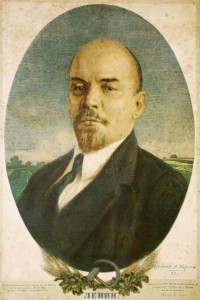
Eberling, Alfred Rudolfovich
December 22, 1871, Zgierz, Piotrków Governorate (Poland), Russian Empire; died 1951, Leningrad, USSR
Born into a peasant family, Alfred Rudolfovich Eberling began drawing classes in Warsaw during the early 1880s. He thereafter undertook studies at the St. Petersburg Academy of the Arts where he was a student from 1889 to 1899, and under the tutelage of the Russian master painter, Ilia Repin. Eberling was also was a student of the German painter, Franz von Lenbach.
During the 1890s, Eberling moved to Turkey upon the directive of the St. Petersburg Academy of the Arts. While in Turkey, he worked on church paintings. By the early 1900s, Eberling began his teaching career, something that would be a major part of his life’s work. As an instructor, he taught at the St. Petersburg drawing school of OPKh (Society for the Encouragement of the Arts). Following the Russian Revolution of 1917, Eberling participated in the development of the Petrograd (St. Petersburg) School of Technical Drawing, later named the Higher School of Decorative and Applied Arts under Vkhutein (Higher Artistic-Technical Institute). Eberling also was an instructor at the institute. In the mid-1920s, he managed the workshop of the Leningrad branch of A.Kh.R.R. (Association of Artists of Revolutionary Russia).
At the invitation of the Russian painter Isaak Izrailevich Brodskii, Alfred Eberling filled the position of professor of painting, drawing and composition at the Leningrad Academy of Arts named for Il’ia Repin. Around 1940, he went on to teach at the art studio of the Leningrad Palace of Pioneers.
From the 1920s to the 1930s, the artist worked on commissions assigned by Goznak (Upravleniе fabrikami zagotovleniia gosudarstvennykh znakov), the Department of State Currency. Eberling created banknote portraits of Karl Marx, Josef Stalin, Mikhail Kalinin, and Vladimir Lenin. His portrait of Lenin was one of the most iconic, and for over a decade, the design was used on the one-hundred-ruble banknote. Furthermore, Eberling won a competition for designing the note’s portrait.
In the pre-revolutionary period, the artist presented his works at various exhibitions such as, the
Society of Watercolorists, the Community of Artists, and the Society of Individualist Artists.
Published sources indicate the artist was born, Wilhelm Alfred Genrikhovich Eberling.
Sources & Citations
Speranskaia, E. A. (Ed.) (1971). Agitatsionno-massovoe iskusstvo pervykh let Oktiabria: materialy i issledovaniia. Moskva: Isskustvo. (artist bio, Pp.21, 57)
rusmuseumvrm.ru (artist bio)
artinvestment.ru (artist bio, early education)